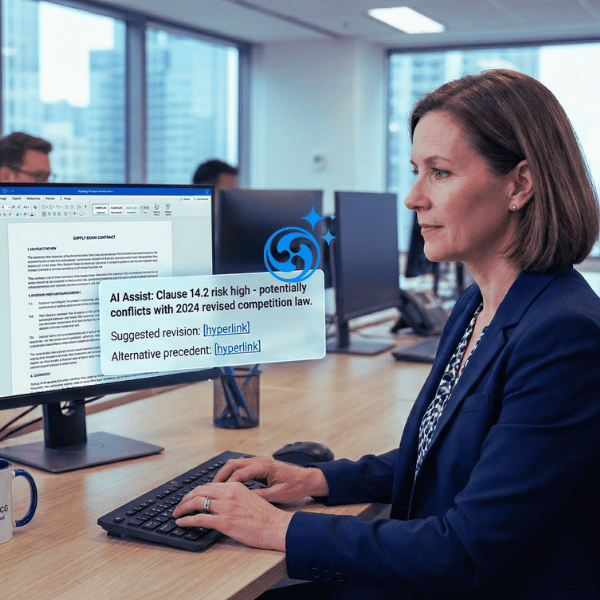
Most explanations of contract management AI stop at the benefits. Faster review, fewer errors, less manual work. Those benefits are real, and we cover the business case for them in how AI is transforming contract management today.
Understanding the mechanics matters because not all AI is built the same way. A tool that pattern-matches keywords behaves very differently from one that understands context, and that difference shows up the first time a contract uses unusual wording for a standard risk.
What technology actually powers contract management AI
Contract management AI is built on three layers of technology working together.
• Natural language processing (NLP): breaks contract text into structured data the system can work with, identifying sentence boundaries, defined terms, and clause types rather than treating the document as a flat block of text.
• Machine learning (ML): classification models trained on large volumes of contract language learn to recognise clause types (indemnity, confidentiality, termination) and flag when a clause deviates from a standard pattern.
• Transformer-based language models: the same architecture behind modern large language models (LLMs) allows the system to understand meaning and context, not just match keywords, so it can tell the difference between a broad indemnity and a narrow one even when the wording is unfamiliar.
Older, rule-based contract software relied on fixed keyword lists and templates. If a clause was not written exactly the way the system expected, it was missed. Language model based systems generalise: they can recognise a non-standard limitation of liability clause even if they have never seen that specific wording before.
How a contract gets from upload to insight
The process behind a single AI-reviewed contract has several distinct steps, even though it appears instant to the user.
• Document ingestion: the contract is uploaded, either manually or through an integration such as Outlook or SharePoint. If it is a scanned or image-based document, optical character recognition (OCR) converts it into machine-readable text first.
• Structural parsing: the system splits the document into its logical parts (clauses, defined terms, schedules) rather than reading it as a single stream of text.
• Embedding generation: each clause is converted into a numerical representation (an embedding) that captures its meaning, which is what allows the system to compare clauses by what they mean rather than the exact words used.
• Classification and scoring: each clause is classified by type and scored against expected risk thresholds, with a confidence level attached to each result.
How AI identifies and classifies clauses
Clause identification is a classification problem. The model has been trained on large volumes of labelled contract clauses, so it learns the patterns that distinguish, for example, a confidentiality clause from a data protection clause, even when they cover related ground.
Once a clause is classified, the system checks it against expected norms for that clause type. This is where anomaly detection comes in: the model flags language that falls outside the normal range it has learned, such as an indemnity clause with unusually broad scope or a payment term with an unusual timeframe. Every flag carries a confidence score, and low-confidence flags are typically routed for human review rather than resolved automatically.
How AI compares your contract against your own policies
Generic clause detection is only useful up to a point. The more valuable capability is comparing a contract against your organisation's policies, playbooks, and precedent library, not just general market norms.
This works through retrieval: when the system encounters a clause, it searches a knowledge base of your approved language, past decisions, and risk thresholds for the closest matches, then uses those matches to judge whether the clause in front of it is acceptable, needs negotiation, or should be escalated. This is the mechanism that separates a policy-aware review from a generic one. Two organisations can run the same contract through the same underlying model and get different risk flags, because the comparison is being made against different internal standards.
How the learning loop works
Contract management AI improves over time through a feedback loop, not a one-off training exercise.
• Every time a lawyer accepts, edits, or overrides an AI-suggested flag, that decision becomes a data point.
• Patterns in those corrections are used to refine how the model scores similar clauses in future contracts.
• Over time, the model becomes calibrated to an organisation's specific risk tolerance and negotiation history, rather than relying only on general legal knowledge.
Because of this, contract management AI that has been in use for a year inside a specific legal team will typically produce more relevant, better-calibrated flags than the same system on day one, even though the underlying model has not changed.
Where AI hands off to the rest of the workflow
Clause analysis and risk detection are only useful if the output goes somewhere. Once a contract has been analysed, the results typically feed into approval routing, negotiation tracking, and e-signature, connecting the technical layer described here to the operational workflow covered in how AI is transforming contract management today.
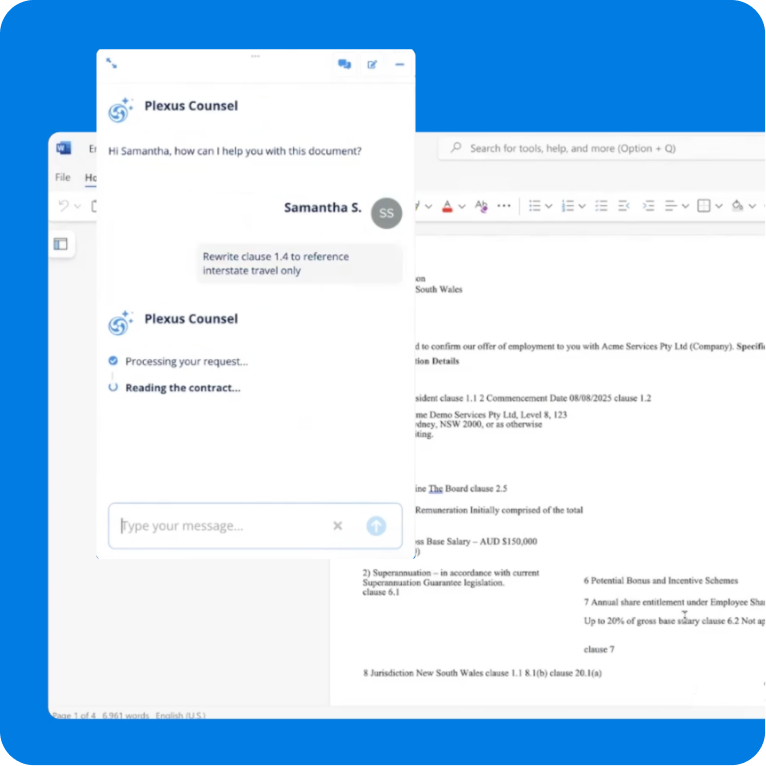
 Meet Plexus Counsel, your new AI-powered digital lawyer
.svg)






.svg)