The right contract management KPIs change that. They give you a factual basis for identifying bottlenecks, communicating performance to leadership, and building the case for better resourcing or tooling.
This guide covers what contract management KPIs are, how to define the right ones for your team, and which metrics are worth tracking in 2026.
What are contract management KPIs?
Contract management KPIs are the measures legal teams use to evaluate how well the business is managing its contracts. They go beyond raw activity tracking to establish clear benchmarks, connecting legal performance to commercial outcomes.
The distinction matters. Metrics tell you what happened. KPIs tell you whether what happened was good, bad, or getting better. A metric says "we executed 40 contracts this quarter." A KPI says "our average execution time was 12 days, against a benchmark of 8."
Effective contract management KPIs should be SMART: specific, measurable, attainable, relevant, and time-bound. Without those qualities, you end up with data that is interesting but not actionable.
Why contract management KPIs matter for in-house legal
Legal functions are under increasing pressure to demonstrate business value, not just legal accuracy. KPIs are the most direct way to do that.
They help you:
-
Identify bottlenecks before they cost the business deals or revenue
-
Prioritise legal time on high-value work rather than routine contracts
-
Surface risk early, when gaps in the process expose the business to unnecessary liability
-
Justify investment in better tooling or additional headcount with evidence
-
Report clearly to leadership in commercial terms, not legal ones
The teams that measure well are also the teams that get more autonomy. When you can show that contracts close faster and with fewer issues under your oversight, the conversation about legal as a bottleneck changes.
How to define contract management KPIs
Step 1: start with business objectives
KPIs that are disconnected from business goals quickly become box-ticking exercises. Before deciding what to measure, get clear on what the business is actually trying to achieve.
Is the priority faster deal execution? Reducing renewal leakage? Cutting the cost of contract administration? The answers determine which metrics are worth your time.
Useful starting points:
-
Review current contracts for alignment with company goals
-
Talk to stakeholders in sales, procurement, and finance about where contracting causes friction
-
Identify where slow or failed contracts have previously cost the business money or opportunity
Step 2: identify the right metrics
Once you know what you are optimising for, choose metrics that directly reflect progress toward those goals. Common starting points for legal teams include:
-
Average time to author a contract
-
Number of contracts sitting with legal for review at any given time
-
Turnaround time for contract approval, negotiation, and execution
-
Cost per executed contract
-
Contract renewal rate
-
Total spend under management
-
Number of new contracts executed per quarter
Not all of these will be relevant to every team. A small in-house team might focus on cycle time and renewal rate. A larger procurement-focused function might weight spend under management more heavily.
Step 3: set targets and benchmarks
A metric without a target is just a number. For each KPI you select, establish:
-
A baseline from historical data (e.g. current average contract execution time)
-
A target you are working toward (e.g. reduce execution time from 14 days to 7)
-
A timeline for achieving it
-
A review cadence to assess progress
Adjust targets regularly as business priorities shift. A benchmark that was right when you had one lawyer managing 50 contracts will not be right when you have three lawyers managing 300.
Key contract management KPIs to track
Contract cycle time
Contract cycle time measures how long it takes a contract to move from initial draft to fully executed. It is one of the most direct indicators of legal efficiency and commercial velocity.
The shorter the cycle time, the faster the business can recognise revenue, begin work under a new supplier agreement, or onboard a new employee. Long cycle times can cause deals to stall, counterparties to lose confidence, or opportunities to close without a signed agreement in place.
Useful sub-metrics within contract cycle time include:
-
Time from request to first draft
-
Time at each approval stage
-
Time in negotiation with the counterparty
-
Time from final sign-off to execution
Tracking by stage helps you pinpoint exactly where contracts are slowing down, which is far more useful than knowing the total cycle time alone.
Cost per executed contract
Every contract carries a cost: legal time, stakeholder reviews, redlines, tool usage, and the administrative overhead of chasing approvals. Tracking cost per executed contract forces the business to be honest about what contracting actually costs.
There is also the harder-to-quantify cost of slow contracts: deals that drag for so long the counterparty disengages, revenue that cannot be recognised until a signature lands, or a hire that falls through because the employment agreement took three weeks to produce.
Making cost per contract visible as a KPI creates the right incentives. Teams become more aware of the time they spend on individual contracts and more motivated to move them forward efficiently.
Contract renewal rate
Contract renewal rate measures the percentage of contracts that are renewed compared to the total number that expired or terminated in a given period. For supplier and customer agreements, this is a leading indicator of relationship health.
Low renewal rates are worth investigating. Common causes include:
-
Missed expiry dates and insufficient lead time to negotiate a renewal
-
Pricing or terms that no longer reflect the market
-
Relationship issues that were not escalated in time
-
Better alternatives from a competitor
Tracking renewal rate month-over-month or quarter-over-quarter surfaces these issues early, when there is still time to act.
Contracts requiring legal review
Tracking the number of contracts sitting with legal for review at any point helps identify whether the legal team is the bottleneck in the contracting process. If the queue is consistently growing, it may indicate under-resourcing, poor triage, or contracts that should not require legal review at all.
This KPI also supports the case for automation. If a significant proportion of contracts in the review queue are low-risk, high-volume agreements (standard NDAs, template employment agreements), that is a strong signal that self-service contracting tools or pre-approved templates could free up significant legal capacity.
How technology supports contract management KPIs
Contract management software solves this by capturing all contract data throughout the contract lifecycle in a single platform. Execution times, approval stages, renewal dates, and cost data are all recorded automatically and surfaced through built-in analytics.
This makes it possible to:
-
Run reports on cycle time and approval delays without manual data gathering
-
Set automated alerts for contracts approaching renewal, so nothing is missed
-
Identify which contract types or business units generate the most legal overhead
-
Track progress against KPI targets in real time rather than at the end of the quarter
Plexus customers use the platform to reduce contract execution time by up to 90% and generate contracts in minutes using pre-approved templates, without requiring legal review on every engagement. See how it works.
Putting KPIs in context
Contract KPIs sit within a broader contract management framework. If you are building out measurement for the first time, it helps to understand the full lifecycle you are measuring against, from initial request through drafting, negotiation, approval, execution, and renewal.
Teams that have measurement in place but are still seeing poor outcomes often find that the issue is process, not effort. Reviewing your contract lifecycle management approach alongside your KPIs gives you the full picture.
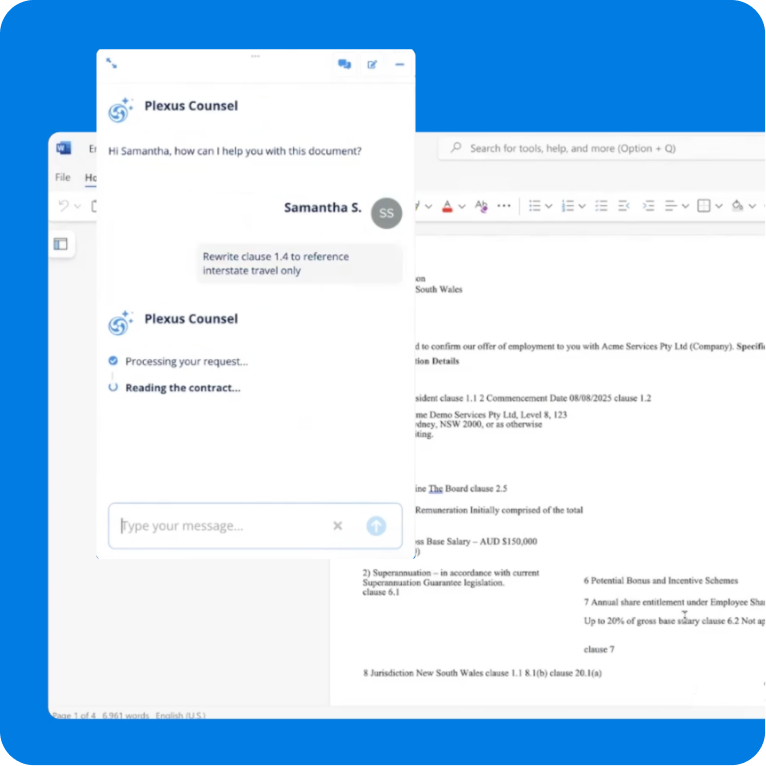
 Meet Plexus Counsel, your new AI-powered digital lawyer
.svg)









.svg)