That gap is not a technology problem. The technology exists, it works, and in many cases it works extraordinarily well. The gap is an execution problem, and it is widening every quarter.
The Plexus Future-Ready General Counsel 2026 survey asked more than 150 general counsel across Australia, the US, New Zealand and EMEA to describe their current relationship with AI. The results were not surprising in the direction of ambition. GCs know AI is important. They are not sitting on the sidelines waiting to hear about it. What is striking is the distance between where they say they want to be and where the data shows they actually are.
When we mapped the responses onto a maturity spectrum, four clusters emerged. Understanding which one your team sits in, and what is actually holding you there, is the most productive starting point for any AI strategy conversation.
Stage 1: Experimenting
Where 58.7% of legal teams currently sit
What it looks like
Experimentation is the mode most legal teams default to when they begin engaging with AI. They are asking it to summarise documents, testing prompts, exploring what the technology can do in low-stakes settings. There is genuine curiosity here, and genuine value, but it is individual and unstructured. No one has defined what a good outcome looks like. There is no playbook for how findings get shared or turned into process.
Why teams stay stuck here
The experimenting stage is comfortable because it carries no accountability. Nothing is being committed to, no budget is at risk, and there is always another tool to evaluate. The problem is that most teams have been in this phase for two years and show no clear path out of it. Experimentation without a defined next step is not a strategy. It is a way of feeling like progress is happening without requiring any of the organisational work that real progress demands.
Teams also stay stuck here because they conflate individual AI use with organisational AI capability. A few lawyers using ChatGPT to draft emails is not an AI-enabled legal function. But it can feel like one, especially if there is no benchmark to compare against.
What it takes to move forward
The transition out of experimenting requires a decision: commit to a use case, define what success looks like, and treat the next phase as a programme rather than an activity. The starting point is almost always the same. Pick the highest-volume, lowest-risk legal workflow and ask: what would it look like to automate the first step? For most teams, that is contract intake and first-pass review.
Stage 2: Piloting
Where 35.3% of legal teams currently sit
What it looks like
Piloting represents meaningful progress. These teams have a vendor, a defined use case, and a cohort of early adopters. They are generating real outputs from AI, and in many cases those outputs are impressive. Contract review times have dropped. Routine queries are being handled by AI rather than landing in the GC's inbox. There is evidence of value.
Why teams stay stuck here
Pilot paralysis is one of the most common patterns in legal AI adoption. The pilot runs, the results are positive, and then nothing happens. The reasons vary, but they cluster around three themes: the success criteria were not clearly defined before the pilot started, so there is no agreed threshold that triggers a decision; the budget for full deployment was never secured, so a good pilot result does not automatically unlock funding; or the organisational change required to scale has not been planned for, and the prospect of it is daunting.
There is also a subtler dynamic. Pilots are safe. They can be pointed to as evidence of action without requiring a commitment. Some teams run pilots not to test and decide, but to indefinitely defer a decision they are not ready to make.
What it takes to move forward
The discipline to exit a pilot requires pre-agreement on decision criteria. Before a pilot starts, the GC should document: what metric, at what threshold, within what timeframe, will trigger a decision to scale. Without that agreement, pilots do not end. They just keep going until the energy behind them dissipates.
Stage 3: Scaling across functions
Where 13.3% of legal teams currently sit
What it looks like
Scaling teams have converted their pilot wins into operational capability. AI is not being used by a few enthusiasts. It is embedded in how the function works, with defined workflows, trained users, and measurable outputs. The GC is no longer asking whether AI is valuable. They are asking where to deploy it next.
Why this stage matters
Teams in the scaling stage are building something that the experimenting and piloting cohorts are not: institutional capital. Every matter that passes through an AI-assisted workflow contributes to the system's understanding of the organisation's legal work. Standard positions, risk tolerance, escalation patterns, all of it is accumulating in a way that makes the next matter faster and more accurate than the last.
What separates scalers from piloting teams
The single most reliable predictor of whether a team moves from piloting to scaling is whether they have a written AI strategy. Teams with a documented strategy are 3.5 times more likely to report significant AI benefits than those without one, according to Thomson Reuters' Future of Professionals research. The strategy does not need to be complex. It needs to exist, and it needs to define the sequence of workflows to automate, the outcomes to measure, and the owner responsible for making it happen.
Stage 4: Fully operationalised
Where only 6.7% of legal teams currently sit
What it looks like
Fully operationalised teams have changed how the legal function works. AI is not a feature they use occasionally. It is embedded in the operating model. Matter intake is automated. Contract first-pass is AI-assisted. Routine queries are handled by AI before they reach a lawyer. The legal function is genuinely scalable in a way that the 1:500 lawyer-to-employee model never was.
What got them there
The 6.7% are not better resourced than the experimenting majority. They are not at larger organisations or more sophisticated technology environments. What they share is a consistent set of decisions: they wrote a strategy before they bought a tool; they chose workflow automation over point tools; they measured outcomes rather than usage; they ring-fenced budget and named an owner; and they treated AI implementation as a change management programme with executive sponsorship, not a technology project managed out of the legal inbox.
The barriers that explain the gap
When we asked GCs to name their greatest implementation challenges, the results were clarifying. Budget was the top answer, cited by 30% of respondents. Change management and deployment came second at 17.5%. Knowing where to start came in at 14.6%. Finding the time at 15.2%.
Notice what does not appear at scale. Vendor selection at 5%. Team buy-in at 4%. The technology itself barely registers.
The barriers are not technical. They are organisational. And that matters, because it means no new model release or product improvement is going to close the gap between experimenting and operationalised. That transition requires a different kind of work: clear ownership, ring-fenced resource, a written plan, and the discipline to follow through.
The teams at the front are pulling further ahead every quarter. Awareness is solved. Operationalisation is the frontier.
Source: Plexus Future-Ready General Counsel 2026 Survey, n=150 General Counsels, January 2026. External citations: Thomson Reuters Generative AI in Professional Services Report 2025; ACC/Everlaw GenAI Survey 2025, n=657; Gartner Legal and Compliance Leader research 2025.
Ready to find out where your team sits on the maturity spectrum? Take the AI maturity assessment or explore the Plexus platform.
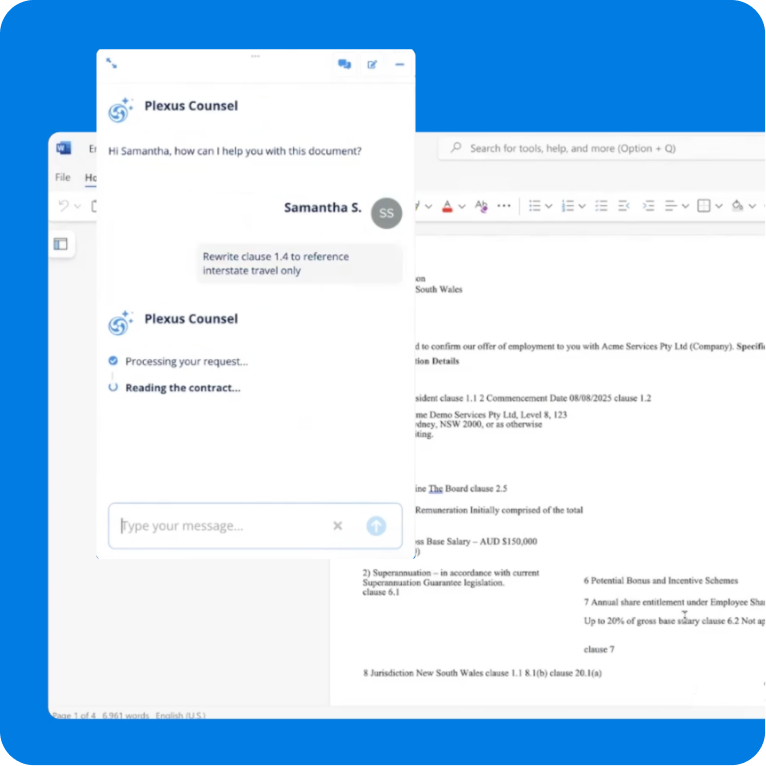
 Meet Plexus Counsel, your new AI-powered digital lawyer
.svg)









.svg)