Before a deal is discussed, before a partnership is explored, before a new hire is briefed on anything sensitive, the non-disclosure agreement (NDA) is usually the first document exchanged. It is one of the most common legal instruments in business, and one of the most frequently mishandled.
For many organisations, getting an NDA over the line takes days. It should take hours. The gap between those two realities is not a legal problem. It is an operational one and it sits at the heart of what Plexus was built to solve.
This guide explains exactly what an NDA is, what it means to sign one, and how the world's leading enterprises are replacing slow, manual NDA processes with automated, policy-controlled workflows that protect the business without slowing it down.
What does NDA mean?
In short: NDA stands for Non-Disclosure Agreement. It is a binding legal contract obligating one or more parties to keep defined information confidential and not share it with unauthorised third parties.
NDA stands for Non-Disclosure Agreement. It is a legally binding contract between two or more parties that establishes a confidential relationship. The party, or parties, who sign an NDA agree not to disclose the covered information to any unauthorised third party.
NDAs are also referred to as confidentiality agreements (CAs), confidential disclosure agreements (CDAs), proprietary information agreements (PIAs), and secrecy agreements. All of these terms refer to the same type of legal instrument. In Australian and UK business contexts, NDA and confidentiality agreement are the most commonly used terms.
The purpose of an NDA is straightforward: it allows parties to share sensitive information freely in order to explore a potential relationship, without that information being used against them or passed on to others. Without it, the conversation cannot happen safely.
What is NDA meaning in business?
In short: In business, an NDA protects commercially sensitive information -- including trade secrets, financials, product plans, and client data, shared between parties before a formal commercial relationship is in place.
In a business context, an NDA is the legal foundation for sharing sensitive information safely. Companies use them constantly: during M&A due diligence, technology licensing discussions, employment negotiations, supplier onboarding, and investor conversations.
The commercial logic is simple. Businesses cannot grow without sharing sensitive information. But sharing that information without legal protection creates serious risk. An NDA defines precisely what is confidential, who can access it, and what the consequences are for unauthorised disclosure.
In a business context, an NDA is the legal foundation for sharing sensitive information safely. Companies use them constantly: during M&A due diligence, technology licensing discussions, employment negotiations, supplier onboarding, and investor conversations.
The commercial logic is simple. Businesses cannot grow without sharing sensitive information. But sharing that information without legal protection creates serious risk. An NDA defines precisely what is confidential, who can access it, and what the consequences are for unauthorised disclosure.
Common business situations where an NDA is required:
-
M&A and investment discussions - financial data, customer lists, and intellectual property must be protected before any deal closes
-
Product development partnerships - technical specifications, roadmaps, and proprietary processes
-
Employment and contractor onboarding - trade secrets, client lists, and internal strategies
-
Supplier and vendor negotiations - pricing, operational data, and commercial terms
-
Fundraising and investor discussions - business models, financial forecasts, and strategic plans
David Rifkind, General Counsel at Caidya, a global clinical research organisation describes the shift his team experienced after implementing Plexus:
When I first joined this company and most companies start to finish on an NDA might be three days. So back and forth could take three to five days. With our self-service function, it's 30 minutes. Send the business people gather the information, fill it in. It comes to me. I say, this looks good to me. We send it to the other side through the system. They can make whatever changes they want to make in the system. If their changes look good, it comes back to me for signature and we're done. You know, it just speeds things up tremendously. But when you think about that, that's the start of every business relationship starts with the confidentiality agreement. If you're wasting three days getting that done, you're slowing the business down. If you can do it all in the space of a few hours, it's perfect.
David Rifkind, General Counsel, Caidya
Three to five days down to 30 minutes. That is not a marginal improvement, it’s a fundamental shift in how the business operates. And as Rifkind notes, it matters because the NDA is not administrative overhead. It is the starting point for every commercial relationship.
Through the Plexus Contracts platform, Caidya's legal team built approved NDA templates once, with policy controls embedded. Business users now initiate, populate, and send NDAs themselves. Legal reviews and approves rather than drafting from scratch. The counterparty negotiates directly through the system. Every step is tracked. Nothing sits in an inbox waiting.
What does signing an NDA mean?
In short: Signing an NDA creates a binding legal obligation to keep specified information confidential. Breach can result in injunctions, significant damages, and in some jurisdictions, criminal liability.
When you sign an NDA, you are entering into a legally enforceable contract. The obligations it creates are serious and specific:
-
You agree not to disclose the defined confidential information to any unauthorised party
-
You agree to use the information only for the purpose specified in the agreement
-
You accept legal liability if you breach those obligations, including the risk of injunctions, damages, and in some cases criminal liability
-
You are bound for the duration specified, which may be a fixed term or indefinite
Courts in Australia, the UK, and internationally have consistently enforced NDA provisions and awarded significant damages for breach. This is why the quality of an NDA matters just as much as having one at all.
A poorly drafted NDA, one with vague definitions, over broad scope, or missing clauses, may not hold up when tested. Most businesses discover this too late, after an incident has already occurred.
Plexus addresses this directly. The Contracts platform provides in-house legal teams with standardised, legally reviewed NDA templates. Every NDA generated through the system includes the right clauses, the right definitions, and the right protections, without requiring a lawyer to review each individual document from scratch.
Mutual NDA vs one-way NDA: what is the difference?
In short: A one-way NDA binds only the receiving party. A mutual NDA binds both parties equally and is the standard structure for business negotiations where both sides share confidential information.
There are two primary NDA structures, and using the wrong one for a given situation creates gaps in protection.
One-way (unilateral) NDA
Only one party discloses confidential information, and only the receiving party is bound by the confidentiality obligations. Typical use cases include employment agreements where a business shares proprietary information with a new hire, and contractor or supplier arrangements where only one side is disclosing sensitive data.
Mutual (bilateral) NDA
Both parties share confidential information, and both are bound by identical obligations. This is the standard structure for M&A discussions, joint ventures, and commercial partnerships where both sides have something to protect. It is the most commonly used NDA format in B2B relationships.
The choice of NDA structure is a legal decision, not an administrative one. In practice, many organisations use a single-template approach for all NDAs, which means the wrong structure is often applied by default. Plexus solves this by enabling legal teams to build separate approved templates for each NDA type, and to build intake logic that routes users to the right template automatically based on the nature of the relationship.
What are the key clauses in an NDA?
In short: Every enforceable NDA must precisely define confidential information, specify permitted use, restrict disclosure, name authorised recipients, set a duration, and establish consequences for breach.
The difference between an NDA that protects a business and one that fails in court is almost always in the drafting. These are the clauses that matter:
Definition of confidential information
The agreement must precisely define what information is considered confidential. Vague definitions, such as 'all information shared between the parties' are difficult to enforce because they are either too broad to be meaningful or too ambiguous for a court to apply. Definitions should be specific enough to be enforceable, but broad enough to cover what genuinely needs protecting.
Obligations of the receiving party
This clause establishes what the recipient can and cannot do with the information, including restrictions on use, storage, copying, and disclosure to third parties. It should also specify the standard of care required in handling the information.
Exclusions from confidentiality
Standard NDAs exclude information that is already publicly known, independently developed by the recipient, or required to be disclosed by law or court order. These exclusions are legitimate and necessary, they prevent the agreement from being challenged as unreasonably broad.
Permitted disclosures
Identifies which individuals within an organisation are authorised to access the confidential information, typically employees on a need-to-know basis, legal advisers, and financiers. Limiting access is both good practice and important for enforcement.
Duration
Specifies how long the confidentiality obligations last. Most business NDAs run for two to five years from the date of signing. NDAs covering trade secrets may impose indefinite obligations. The duration should reflect the commercial sensitivity of the information being shared.
Remedies for breach
Establishes the consequences of breach, including injunctive relief, damages, and in some jurisdictions, criminal liability. A well-drafted remedies clause sends a clear signal that the parties take the agreement seriously and makes enforcement more straightforward if a breach occurs.
When NDAs are created manually, clause quality varies significantly depending on who is drafting them and under what time pressure. Plexus removes that variability. Legal teams build the approved clause library once. Every NDA generated through the Contracts platform is consistent, compliant, and enforceable, regardless of which team member initiates it.
When do you need an NDA?
In short: You need an NDA whenever sharing confidential business information with any party before a binding agreement with confidentiality obligations is already in place.
The test is straightforward: if the disclosure of this information to a third party would damage your business, you need an NDA in place before you share it.
Use an NDA:
-
Before sharing financial data, technical IP, or business strategies with any external party
-
At the outset of any M&A, investment, or joint venture discussion
-
When engaging contractors or consultants who will access proprietary systems, processes, or data
-
When onboarding employees into roles involving sensitive commercial information
-
Before sharing client data, product roadmaps, or pricing strategy with suppliers or vendors
-
A broader commercial agreement already contains confidentiality clauses with sufficient scope
-
The information being shared is already publicly available
-
The engagement is entirely non-commercial and involves no proprietary information
You may not need a standalone NDA when:
In practice, the question 'do we need an NDA here?' is often answered inconsistently within organisations, sometimes through instinct, sometimes through habit, and sometimes not at all. This inconsistency creates risk.
Plexus addresses this through the Matters platform, which enables legal teams to build structured intake workflows. When a business user raises a request involving a new commercial relationship, the workflow prompts the right questions, determines the appropriate document type, and routes the request to the correct NDA template, removing ambiguity and ensuring nothing falls through the gaps.
What makes an NDA legally enforceable?
In short: An NDA is legally enforceable when it satisfies basic contract requirements, uses precise definitions, applies reasonable scope, and is properly executed by parties with authority to bind their organisations.
For an NDA to be legally enforceable in Australia and most common law jurisdictions, it must satisfy the following:
-
Contract fundamentals: offer, acceptance, and consideration. In most business NDAs, consideration is the mutual exchange of confidential information or the promise to enter into a commercial discussion
-
Precise definitions: courts have consistently held that NDAs with vague or impossibly broad definitions of confidential information are difficult to enforce
-
Reasonable scope: an NDA that purports to restrict publicly available information, or that imposes obligations beyond what is commercially reasonable, may be found unenforceable
-
Proper execution: signatures from parties with authority to bind their respective organisations. For companies, this typically means a director, officer, or authorised signatory
-
Governing law: the agreement should specify which jurisdiction's law governs it and where any disputes will be resolved
Most enforcement failures come down to drafting quality, not intent. An NDA that was agreed to in good faith by both sides can still fail to protect a party if its definitions are too vague, its scope too broad, or its clauses inconsistent.
This is why template quality matters enormously and why the ad hoc, one-off drafting approach that many organisations rely on creates ongoing legal exposure. Plexus provides legally reviewed, policy-compliant NDA templates as a baseline. Legal teams validate them once. Every subsequent NDA generated by the business inherits that quality.
The real cost of slow NDA processes
In short: When NDAs take days to complete, businesses lose deals, delay partnerships, and frustrate stakeholders. The operational cost of a slow NDA process compounds across hundreds of transactions every year.
The NDA is not a bureaucratic formality. It is the commercial starting pistol. Every day it takes to get a signed NDA in place is a day the actual relationship cannot begin.
The Caidya story captures this shift precisely. Here is Rifkind on what that change looks like in practice:
Three to five days down to 30 minutes and legal still in control at every step. That is what a well-designed NDA workflow delivers:
Speed
Business users do not wait for legal. They initiate the NDA themselves through a guided self-service process, populate the required fields, and submit for review. Legal reviews and approves in minutes rather than drafting from scratch over hours. The counterparty receives the document through the system and can respond without external email chains.
Quality
Every NDA generated through Plexus uses an approved template, not a cached version from someone's desktop, not a document repurposed from a previous deal, and not a draft produced under time pressure without proper review. The same quality standard applies every time.
Visibility
Once an NDA is executed, it does not disappear into an email inbox or a shared drive. Plexus maintains a centralised record of every agreement, its status, its obligations, its expiry date, and the parties involved. Legal has full visibility. The business has confidence that its confidential relationships are tracked and protected.
How enterprises manage NDAs at scale with Plexus
In short: Enterprises use the Plexus Contracts platform to automate NDA generation, enforce policy-controlled templates, enable e-signature, and maintain centralised tracking -- without routing every document through legal.
For large enterprises with a 1:500 lawyer-to-employee ratio, manual NDA management is not a sustainable operating model. Legal teams are stretched. The volume of transactions requiring NDAs across sales, HR, procurement, and operations is too high for every document to be individually drafted and reviewed.
The consequence is a familiar pattern: some NDAs are rushed and poorly drafted, others are delayed and hold up commercial relationships, and others are not created at all, leaving the business exposed.
Plexus solves this by separating the legal work (designing the template, setting the policy, maintaining compliance) from the operational work (initiating the document, gathering information, coordinating with counterparties). Legal does the former once. The business executes the latter independently, every time.
The result in practice:
-
Sales generates and sends a mutual NDA to a prospect before the first meeting ends
-
HR issues NDAs to new contractors as part of a standardised onboarding workflow
-
Procurement executes confidentiality agreements before vendor due diligence begins
-
Legal retains oversight, policy control, and visibility, without being a bottleneck on each individual transaction
|
65%
increase in legal team productivity
|
45%
reduction in contract turnaround time
|
400x
faster than manual legal processes
|
Companies including Coca-Cola, Nike, PepsiCo, Woolworths, and L'Oreal use Plexus to scale legal work across their enterprises. For these organisations, the NDA is no longer a bottleneck. It is a process, predictable, consistent, and fast.
NDA meaning: the bottom line
A non-disclosure agreement is a binding legal contract that protects confidential information shared between parties. It is the starting point for almost every business relationship and the quality and speed with which an organisation handles its NDAs says a great deal about the maturity of its legal operations.
Organisations that treat the NDA as a manual, case-by-case process will always be slower, more inconsistent, and more exposed than those that have built a proper system around it. The difference is not a function of team size or legal budget. It is a function of design.
Plexus gives in-house legal teams the infrastructure to do this well. The Contracts platform automates NDA generation, enforces policy compliance through every template, enables e-signature, and provides centralised tracking across every agreement the business executes. Legal sets the standard once. The business meets it every time.
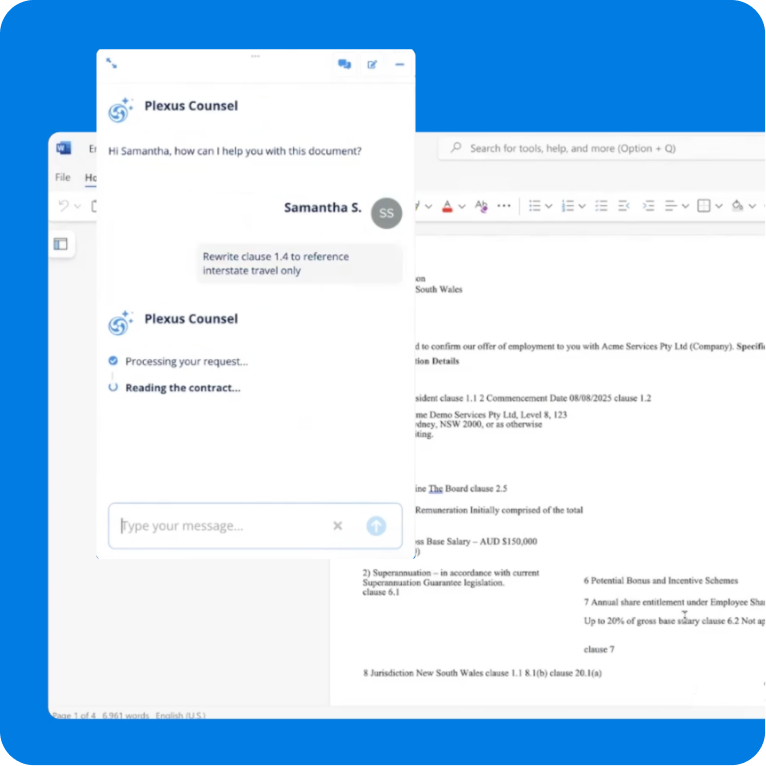
 Meet Plexus Counsel, your new AI-powered digital lawyer
.svg)






.svg)