Legal teams everywhere are under increasing pressure to do more with less, as the volume and velocity of legal decisions across organisations continue to rise.
In fact, according to Gartner, 85% of legal decisions made in the business go unsupported by Legal. The impact of this gap is felt clearly across organisations. Three in five employees say they don’t get the legal support they need, and 75% say that even when they engage Legal, they don’t see sufficient value from the interaction.
This is not a reflection of lawyer capability or commitment. It is a structural issue. The traditional model of legal support simply does not scale to meet the reality of how modern businesses operate.
Why traditional legal models no longer scale
Most legal teams are still organised around a reactive service model. Requests are triaged, advice is drafted manually, and lawyers are pulled into an ever-growing volume of routine work. Meanwhile, the majority of legal risk is created outside the legal function by employees making everyday decisions that never reach Legal at all.
The result is a fundamental mismatch. A small legal team is attempting to support an organisation where legal risk is created everywhere, every day.
No matter how well resourced, it is impossible for a legal team of any size to personally support every decision that impacts legal risk across the business.
A shift from legal capacity to legal coverage
The future of legal work is not about increasing headcount or pushing harder on the same operating model. It is about expanding legal coverage, not just legal capacity.
Progressive legal teams are rethinking how legal support is delivered, moving from a model in which Legal responds to requests to one in which legal intelligence is embedded directly into how work gets done.
This shift enables legal guidance to reach more people earlier in the decision-making process, without requiring lawyers to be involved in every interaction.
From reactive support to embedded legal intelligence
In the future state, legal work is no longer confined to the inbox or the ticket queue. Legal guidance is delivered through workflows, tools, and systems that reflect how the business actually operates.
Routine drafting, issue spotting, and first pass analysis can be handled through intelligent systems, while lawyers focus their time where it matters most. Complex judgment, strategic advice, and high-risk matters.
Crucially, this model does not remove lawyers from the equation. Instead, it ensures legal judgment is applied more consistently, more proactively, and at far greater scale.
What this means for legal teams
As legal work continues to grow in volume and complexity, the role of the legal function is evolving.
The most effective legal teams will be those that extend legal guidance beyond the legal team itself, reduce friction for the business while maintaining control, apply legal judgment earlier rather than only at the point of escalation, and use technology to scale impact rather than simply manage workload.
In this future, Legal is no longer a bottleneck or a last line of defence. It becomes an embedded, intelligent partner to the business, supporting better decisions wherever and whenever they are made.
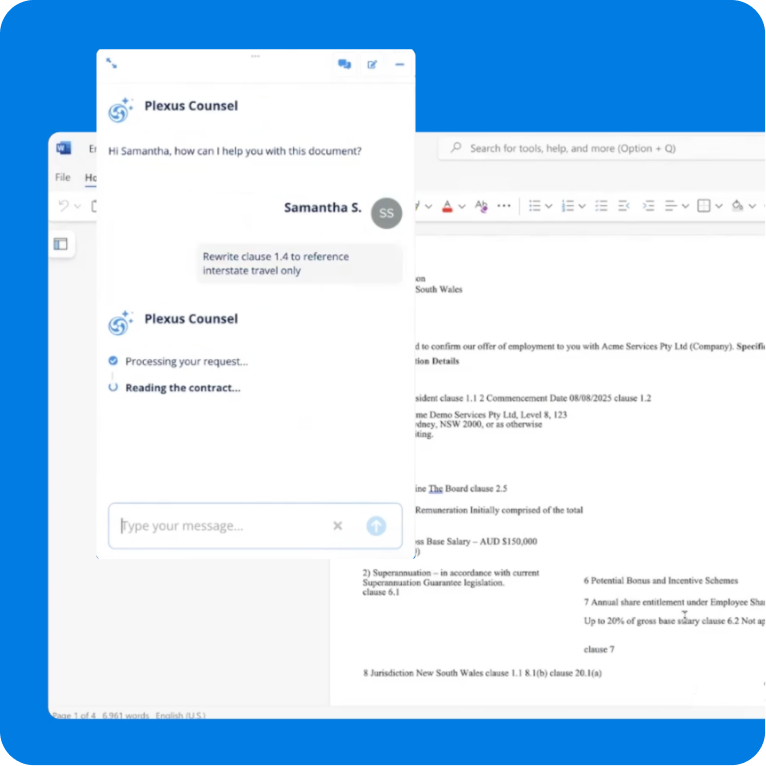
 Meet Plexus Counsel, your new AI-powered digital lawyer
.svg)